CRUISING TO :
|
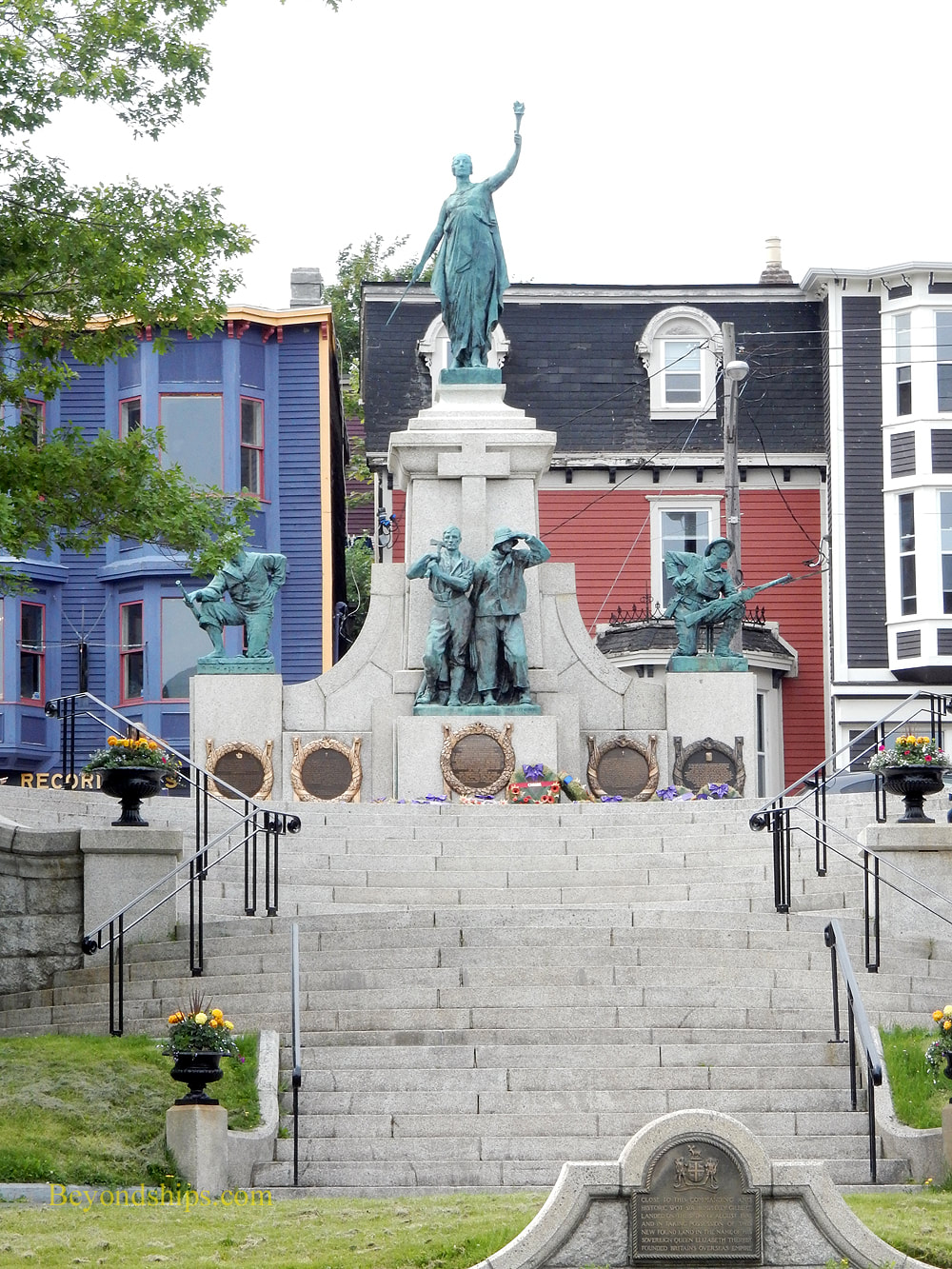
The War Memorial
|

Above: St. John's is the eastern end of the Trans-Canada Highway.
Below: The province is the home of two popular breeds of dog - the Newfoundland dog and the Labrador Retriever. 
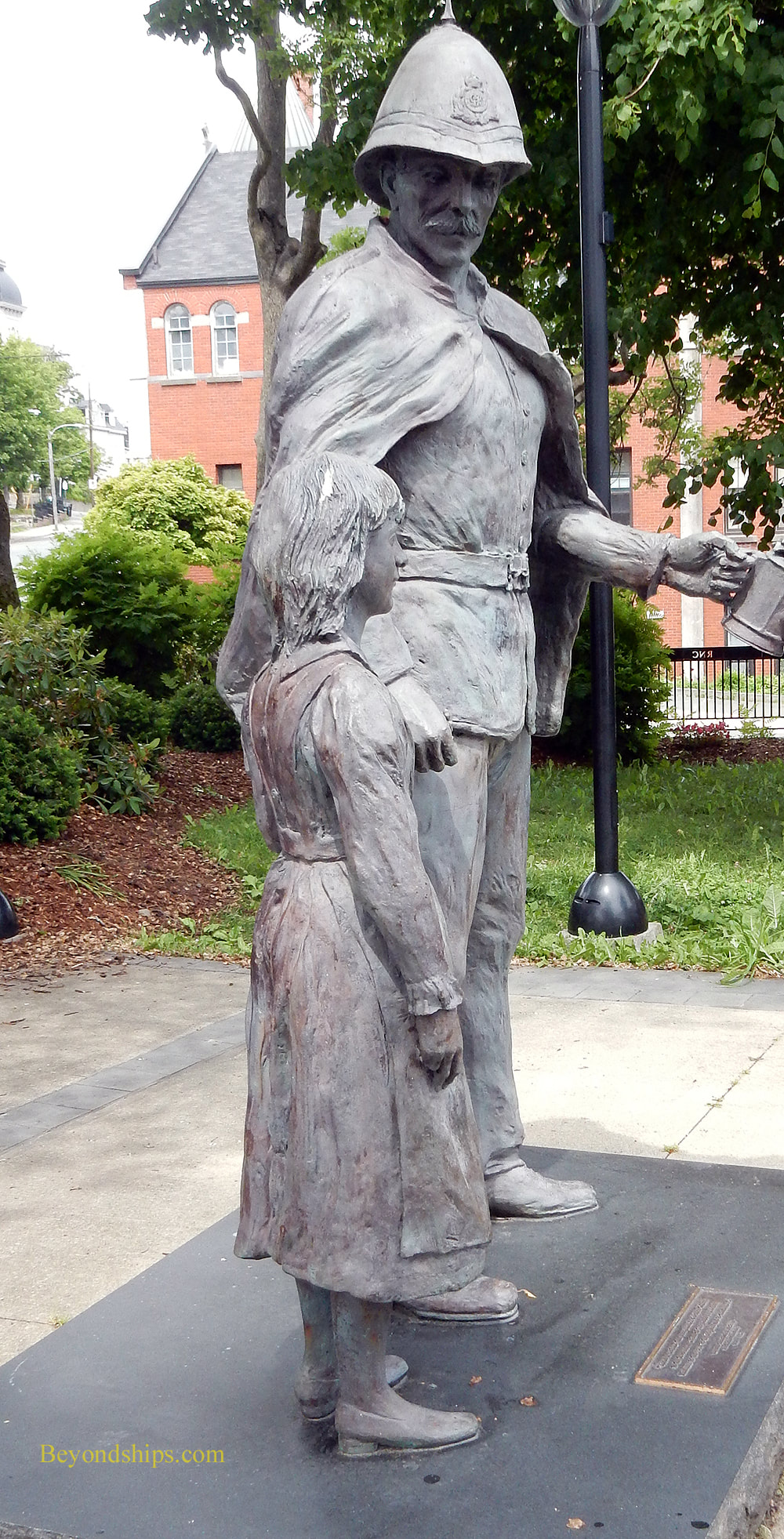
A statue paying tribute to the Royal Newfoundland Constabulary.
|
St. John's history extends back into the mists of time. It is known that native people were here some 10,000 years ago. About a thousand years ago, the Vikings came and briefly settled. John Cabot, an Italian explorer sailing for King Henry VII of England, "discovered" the island in 1497. Still, it was not until 1583 that Sir Humphrey Gilbert claimed the area for England.
The waters off Newfoundland were rich in fish. Therefore, fishermen from England and other European countries were attracted to the area. At first, they came seasonally but gradually, they began to stay year round despite legal prohibitions on such permanent settlement. St. John's was established as a settlement around 1630. By 1675, St. John's had a population of 271 people. St. John's was temporarily seized by the Dutch cn 1665. However, a second Dutch attack in 1673 was repulsed by a small group who had taken the cannons off a merchant ship and placed them by the Narrows, the entrance to St. John's harbor. For more than a century, St. John's saw war with France. The French destroyed the town in 1696. In 1705, they attacked and damaged the re-built town and in 1708. The final battle of the French and Indian War (Seven Years War) was fought in 1762 on Signal Hill by the entrance to the harbor. The British defeated the French who had captured the town earlier that year.I By the 19th century, the population had grown to 5,000. The economy was still dependent on fishing. However, St. John's was also a military garrison and government center. The Great Fire of 1892 destroyed much of the city. Consequently, most of St. John's buildings date from after 1892. Just after the turn of the century, St. John's was in the spotlight when Guglielmo Marconi received the first transatlantic wireless message at his station atop Signal Hill. A few years later, the first transatlantic airplane flight took off from St. John's. Due to its location in the Atlantic, St. John's played an important role in both World Wars. It acted as an assembly point for convoys and provided supplies and repairs to ships combating German submarines. The collapse of the fishing industry in the 1990s brought high unemployment. However, St. John's proxiity to offshore oil and gas fields created an economic boom in the next decade. |
Cruise destination profile - St. John's, Newfoundland, Canada - history