DESTINATION:
History |
|
|
The area around Quebec has long been inhabited. In fact, the name Quebec is a corruption of an Algonquin word, kerbec, meaning place where the river narrows.
In 1534, French explorer Jacques Cartier was the first European to visit the area. He named the promontory overlooking the river where the Citadel is now located ‘Cap Diamant’ because he thought diamonds and other precious jewels would be found there. Cartier’s hopes proved unfounded and it was not until 1608 that the first successful commercial venture took place when Samuel du Champlain opened a fur-trading post at Quebec. He was soon followed by other French people who settled around the trading post in the area now known as the Lower Town. At this time, France and her traditional rival Great Britain were struggling for control of North America. Consequently, Quebec was attacked several times by British forces. The decisive battle took place during the Seven Years War (also known as the French and Indian War) on the Plans of Abraham, just outside the city walls. The British under General James Wolfe had been besieging Quebec City for three months. Their encampments were on the Ile d’Orleans and the south bank of the river. The north bank including Quebec City was controlled by French General Louis-Joseph, Marquis de Montcalm. Although the French outnumbered the British, the French force included large numbers of militia and guerrillas whereas the British were regular soldiers. Nonetheless, the French in their fortified positions were able to repulse the British assaults. As the summer dragged on and disease swept their camp, British morale sank. Wolfe then decided on a bold move. He would land a small number of soldiers west of the city who would then scale a 174 foot cliff at night and take the French position that guarded that point along the river. The rest of the army would land and assemble on the plateau above the river. This would force Montcalm to come out of his fortifications and fight because it would threaten his supply line to Montreal. The French did not believe that they could be attacked from the west and so it was not heavily defended. The British assault team did its job and on the morning of 13 September 1759, Montcalm awoke to find the British army formed up on Abraham Martin’s farmland. Concerned that the British would build entrenchments if given time, Montcalm decided to attack immediately without waiting for his entire army to gather. This turned out to be a mistake as within 15 minutes the battle was over and the British had captured the city. Both Wolfe and Montcalm were mortally wounded. While other battles would follow over the next four years, the Battle of Quebec spelt the end of French control of Canada. During the American War for Independence, revolutionary soldiers from the American colonies led by Benedict Arnold attacked the British garrison at Quebec. The plan was to free the Canadian colonists so that Canada could join the newly formed United States. Arnold’s attack failed and so the British colonies in North America went their separate ways. A second unsuccessful American invasion of Canada was made during the War of 1812 but did not get as far as Quebec. However, concerned that there might be another attack in the future, the British began to build a formidable fortress at Quebec (the Citadel) in 1820. During the 19th Century, Quebec City continued to grow as a governmental and commercial center. In 1867, it was designated the capital of the Province of Quebec in the newly-created Dominion of Canada. It played an important role during World War II as the site of two conferences of Allied leaders. The first in 1943, included U.S. President Franklin D. Roosevelt, British Prime Minister Winston Churchill, Canadian Prime Minister William Lyon Mackenzie King and Chinese Foreign Minister T.V. Soong. The second conference in 1944 was between Roosevelt and Churchill and involved final decision making about the liberation of the European continent from the Nazis |
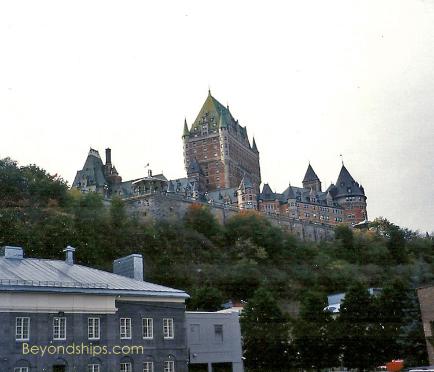
Above: The Chateau Frontenac on the cliff overlooking the river is the best-known landmark in the city.
Below: The Lower Town has been thoughtfully preserved in a way that allows it to have modern cafés and shops without disrupting the historical atmosphere. 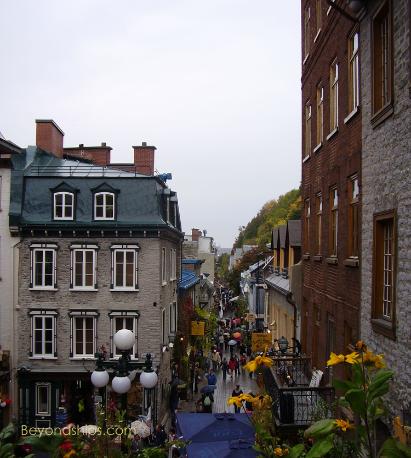
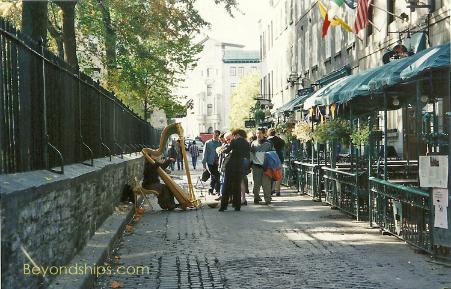
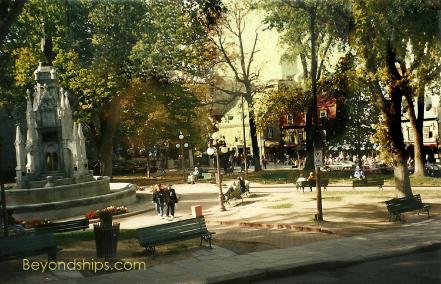
If walking through the Lower Town has the feel of having stepped back in time, the Upper Town has the feel of having stepped across the Atlantic with its European streets and parks.
|
Cruise destination travel guide - - Canada - - Quebec City - - History