Split home page
Cruise destination:
|
|
|
CONTENTS
|
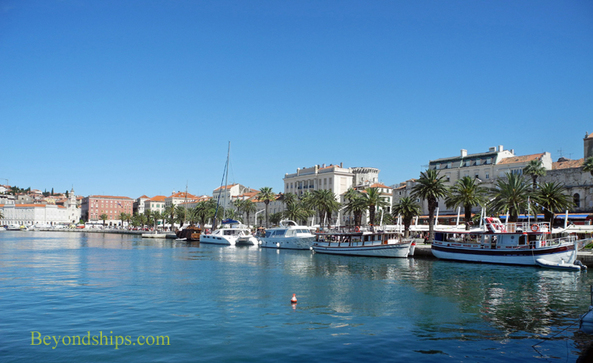
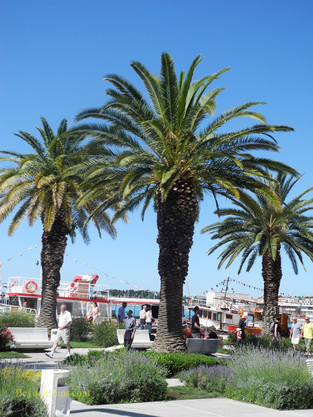
OVERVIEWSituated on a peninsular jutting into the Adriatic Sea, Split is in one of the sunniest locations in Europe. Accordingly, palm trees line the shoreline and a broad seaside promenade, the Riva, is home to numerous outdoor cafes. The atmosphere is something like that of the French Riviera. A city of more than 220,000 inhabitants, Split is the second largest city in Croatia after the capital Zagreb and the largest city in the area known as Dalmatia. Split is a busy economic center. It is an important port and home to chemical, metallurgical and shipbuilding businesses. Conveniently for visitors, most of these industries are located away from the center of the city. That area has been well-preserved with an astonishing number of ancient, Medieval and Renaissance buildings. But while Split has done an excellent job of preserving its heritage, even the city center has the vibrancy of a living city that has a future as well as a past. |
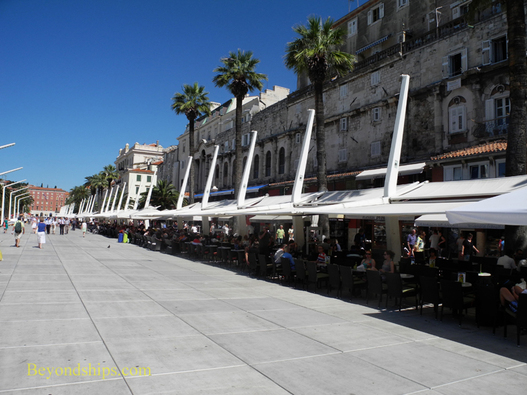
Above: The Riva.
Below: Narrow streets lined with historic buildings characterize the old town. 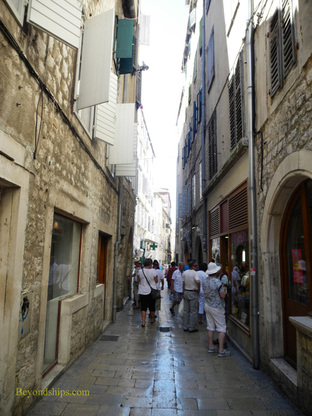
|
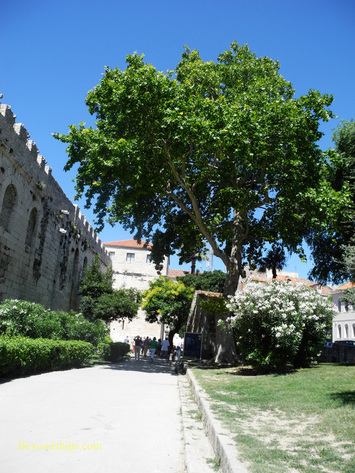
Above: The northern wall of Diocletian's Palace.
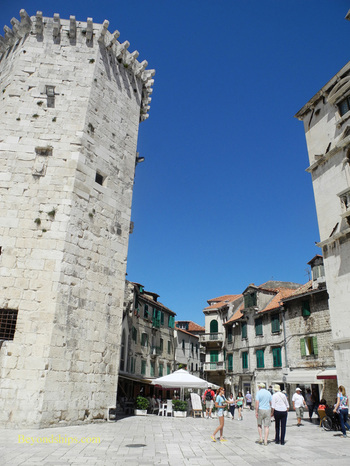
Above: A Venetian tower overlooks the Voćni trg or Fruit Square,
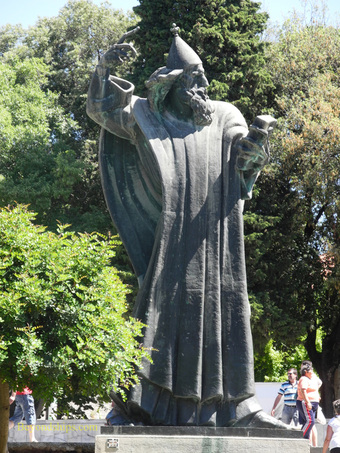
Above: A statue of the 10th century bishop Gregory of Nin, who strongly opposed the pope, by Croatia's most prominent artist Ivan Mestrovic.
|
Brief History The story of Split really begins in 295
A.D. At that time, Split was a settlement in the Roman province of
Dalmatia. It was not far from the provincial capital at Solana but
not particularly significant in itself. Then the Emperor Diocletian
changed everything. He decided that he would take the unprecedented
step of voluntarily retiring. Having grown up in Dalmatia, he
decided that the attractive seaside location of Split would be a good
place to live out his retirement. Therefore, he ordered a huge
palace constructed by the sea in Split.
The palace was completed in 305 A.D. and Diocletian lived there until his death in 313 A.D. For a time, subsequent Roman emperors used the Palace as a retreat. However, as the Roman Empire tottered and fell, the Palace was abandoned. In 614 A.D., the Palace found new life as refugees escaping from invading Slavs and Avars who had razed Solona found safety in the the fortified Palace. A city began to develop within the perimeter of the old Palace. At first, Split was under the rule of Hungarian and Croatian kings. However, Split was autonomous in the 12th and 13th centuries. Then in 1420, Split like much of the rest of the Adriatic came under the control of Venice. It remained that way until Napoleon defeated Venice in 1797. After a brief period of French rule, Split became part of the Austro-Hungarian Empire. That rule ended in 1918 when Austria-Hungary was defeated in World War I. One of the new countries created by the diplomats who drew up the peace treaty following the war was Yugoslavia. Croatia, including Split, was made part of this new country. During World War II, Yugoslavia was invaded by the Axis powers. Split was occupied by the Italians until 1943 and then by the Germans. It was liberated by Marshal Josip Tito's army on October 26, 1944. After the war, Tito became the dictator of Yugoslavia. Although a communist, he managed to avoid complete domination by the Soviet Union. However, his personal control was such that he was able to hold together the disparate collection of states that had been forced together at the end of World War I to become Yugoslavia. Split experienced something of an economic boom under Tito. It became Yugoslavia's largest port and was known for its shipbuilding. When Tito died in 1980, Yugoslavia began to unravel. War broke out between the Serbs and the Croats. During the fighting, Split was bombarded by the Serbian-controlled Yugoslav navy and refugees flocked to the city. Croatia declared independence in 1991. During the 1990s, Split was troubled by an economic recession. However, after the turn of the millennium, the economy began to revive. Re-devlopment projects were instituted and the tourist industry became important as Split became a tourist destination. |
Cruise destination - - Split, Croatia - Overview (home page)